
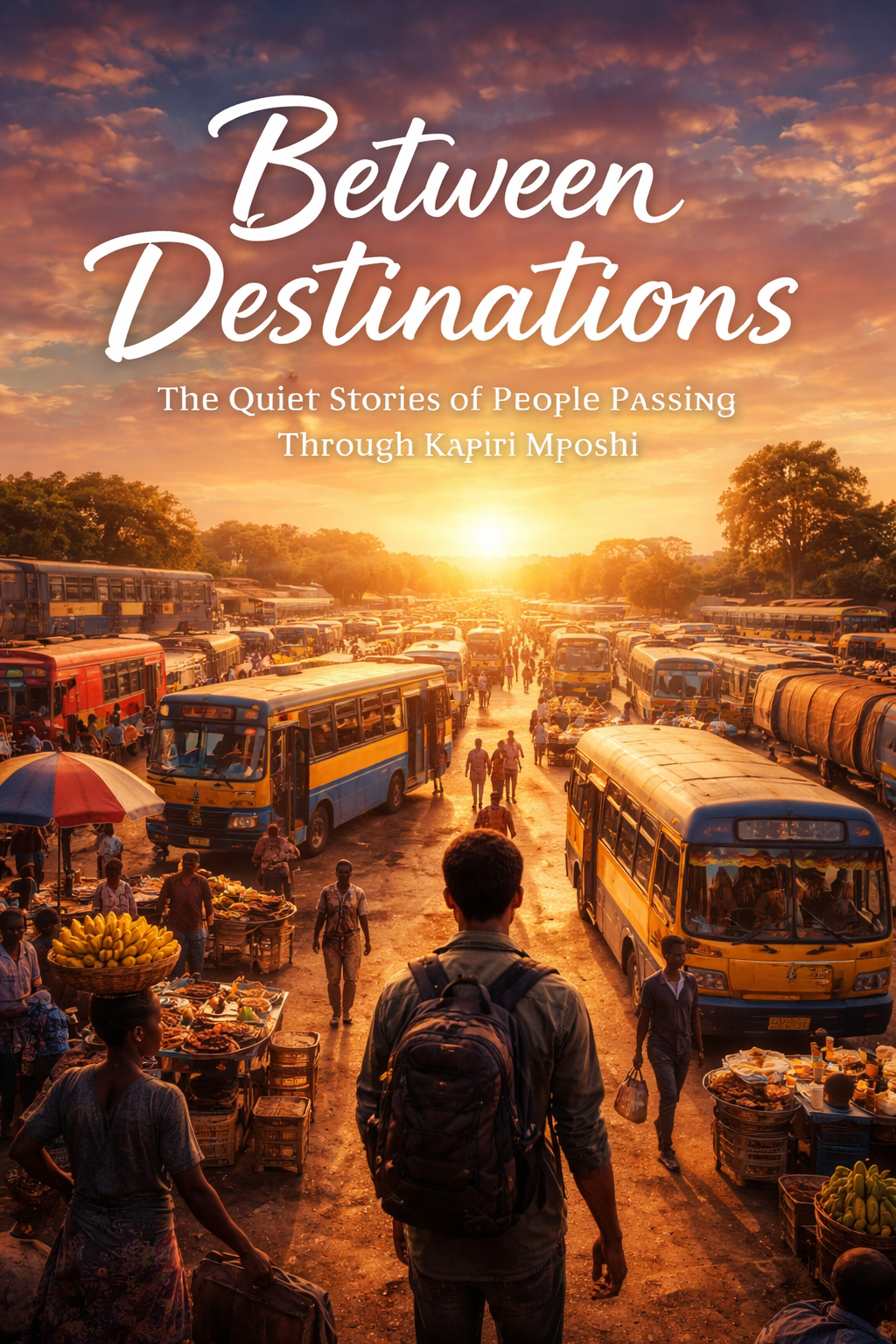
Between Destinations: The Quiet Stories of People Passing Through Kapiri Mposhi

By Derek Mwale
There is a kind of story that never gets told.
Not because it lacks meaning—but because it moves too quickly to be captured.
It exists in bus stations, in roadside stops, in the brief exchanges between strangers who will never meet again. It lives in the in-between spaces of travel, where people are not yet where they are going, but no longer where they came from.
This is where Kapiri Mposhi exists.
Not as a destination, but as a container of passing lives.
A place where thousands of stories brush against each other every day—quietly, briefly, and almost invisibly.
The Man With the Small Bag
He steps off the bus slowly, as if the ground itself needs time to adjust to his weight.
He carries a small bag—too small for a long journey, too deliberate to be random. His eyes scan the surroundings, not with curiosity, but with calculation. He is not here to explore. He is here to pass through.
But something about him suggests this is not just another trip.
Maybe he is leaving something behind.
Maybe he is going toward something uncertain.
In places like Kapiri Mposhi, you learn to read people without knowing them. You notice the details—the way someone holds their belongings, the way they stand, the way they move.
You do not know his story.
But you feel its weight.
And then, just like that, he is gone—back onto another vehicle, back into motion, his story continuing somewhere you will never see.
The Woman Who Sells Time
She stands by the roadside, calling out to passengers as buses pull in.
Her goods are simple—food wrapped in paper, snacks arranged for quick exchange. But what she is really selling is not food.
She is selling time.
Time for travelers who cannot afford to sit down and eat properly.
Time for drivers who need to keep moving.
Time for a system that never fully stops.
She has likely been here for years.
Watching faces change.
Watching buses come and go.
Watching lives pass through her daily routine.
To the traveler, she is part of the background—a necessary convenience.
But in reality, she is one of the anchors of this place.
While everything else moves, she remains.
And in her stillness, she becomes part of every journey that passes through.
Conversations That Do Not Finish
There is something unique about conversations in transit towns.
They begin easily.
“Where are you heading?”
“How far is your journey?”
“Is this seat taken?”
Strangers talk as if they have known each other longer than they actually have.
Maybe it is because they share the same temporary space.
Maybe it is because there is no pressure for the conversation to last.
But just as quickly as they begin, they end.
A bus is called.
A seat becomes available.
A route changes.
And the conversation dissolves.
No goodbyes.
No follow-ups.
No continuation.
Just silence.
And yet, those brief exchanges carry something real.
For a moment, two lives intersected.
For a moment, two stories touched.
And then they moved on.
The Driver Who Knows Every Road
He sits behind the wheel with a kind of calm that only comes from repetition.
He has driven this route more times than he can count.
He knows where the road bends, where it breaks, where it demands attention.
Kapiri Mposhi is not a stop for him.
It is a rhythm.
A checkpoint in a cycle that repeats itself daily.
A place where he measures progress, not in distance, but in familiarity.
He watches passengers come and go.
Some nervous.
Some excited.
Some tired.
To them, this journey is significant.
To him, it is routine.
But within that routine lies something deeper.
He is part of the system that carries stories forward.
He does not create the journeys—but he makes them possible.
The Child Who Sees Everything as New
Among the travelers, there is always a child.
Watching everything.
The buses feel larger.
The voices sound louder.
The movement seems more alive.
For them, Kapiri Mposhi is not just a stop.
It is an experience.
They do not see it as “in-between.”
They see it as something happening right now.
And in that perspective, there is a kind of clarity that adults often lose.
Because while others are focused on where they are going, the child is fully present in where they are.
Not thinking about the next destination.
Not comparing this place to another.
Just observing.
Just experiencing.
Just being.
The Trader Moving More Than Goods
Some travelers carry more than luggage.
They carry purpose.
A trader passing through Kapiri Mposhi is not just moving goods from one place to another. They are navigating a network—buying, selling, negotiating, adapting.
Their journey is not defined by distance, but by opportunity.
Every stop matters.
Every connection matters.
Every delay matters.
Kapiri Mposhi, for them, is not just a pause.
It is a node in a larger system of survival and growth.
A place where decisions are made quickly, where margins are calculated silently, where the next move is always being considered.
They do not linger.
But they do not pass through casually either.
They engage with the space, even if only briefly.
The Weight of Unseen Journeys
What makes Kapiri Mposhi powerful is not what you see.
It is what you do not see.
The reasons behind each journey.
The emotions carried in silence.
The stories that never get spoken aloud.
Someone is traveling to start a new job.
Someone is returning home after a loss.
Someone is leaving a place they may never come back to.
All of this passes through the same physical space.
And yet, none of it is visible unless you look closely.
Transit towns are filled with these unseen narratives.
They are not dramatic in the traditional sense.
But they are real.
And sometimes, reality carries more weight than any story we choose to tell.
A Place That Holds Moments, Not Memories
Most destinations aim to leave a lasting impression.
They want to be remembered.
Kapiri Mposhi is different.
It does not try to stay with you.
It exists in fragments.
A sound.
A face.
A brief interaction.
And then it fades.
But that does not make it meaningless.
In fact, it makes it more honest.
Because not everything in life is meant to last.
Some things are meant to pass through us, just as we pass through them.
The Quiet Truth About Passing Through
We often think of passing through as something temporary, something insignificant.
But the truth is, much of life is spent in transit.
Moving from one phase to another.
From one identity to another.
From one place to another.
Kapiri Mposhi reflects this reality.
It shows you that being “in between” is not an exception—it is the norm.
And within that in-between space, there is meaning.
Not loud, obvious meaning.
But quiet, subtle meaning.
The kind that reveals itself only if you are willing to notice.
Between Destinations
In the end, Kapiri Mposhi is not just a place.
It is a collection of moments.
A series of brief encounters.
A network of passing lives.
A silent witness to journeys that continue beyond its boundaries.
The people who pass through it carry their stories with them.
But for a moment—just a moment—those stories exist here.
Side by side.
Unconnected, yet somehow shared.
And then they move on.
There is something humbling about that.
To realize that your journey, no matter how important it feels to you, is just one of many passing through the same space.
To understand that the world is full of stories that do not revolve around you.
To see that meaning does not always come from staying—it can also come from passing through.
Kapiri Mposhi does not ask you to remember it.
It simply asks you to be present while you are there.
And if you can do that—if you can truly see the people, the movement, the quiet intersections of lives—
Then you begin to understand something deeper.
That between destinations, there is a world.
A world of stories that do not wait to be told.
A world that exists in motion.
A world that you are part of, even if only for a moment.