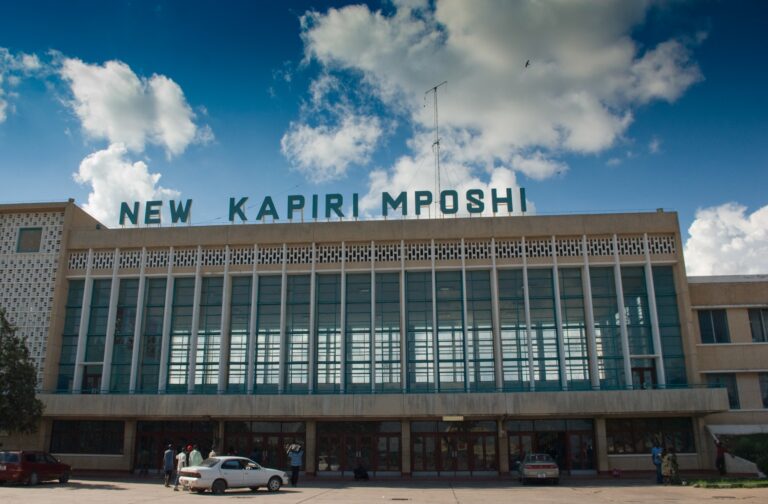

Kapiri Mposhi: The Crossroads of Zambia’s Rail and Road Network

By Derek Mwale
There are places that people pass through, and then there are places that quietly define the act of passing itself. Kapiri Mposhi belongs to the latter.
At first glance, it may appear like just another stop along Zambia’s vast network of roads and rail lines—a functional town, practical in purpose, unassuming in presence. But if you linger long enough, if you observe the rhythm of arrivals and departures, of engines starting and stopping, of conversations cut short by urgency and continued in motion, you begin to understand something deeper: Kapiri Mposhi is not just a stop. It is a meeting point of directions. A hinge between distances. A crossroads in the most literal and existential sense.
In Zambia, movement is not optional—it is structural. The country’s geography demands it. People travel for opportunity, for trade, for family, for survival. And within this constant motion, Kapiri Mposhi emerges not as a destination in itself, but as a system—a living intersection where roads converge and rail lines extend outward like arteries feeding different regions of the nation and beyond.
The Geometry of Movement
To understand Kapiri Mposhi is to understand how geography shapes human behavior. Positioned strategically along major transport corridors, the town sits at a point where routes from Lusaka, the Copperbelt, and central regions intersect. For many travelers, whether by bus, private car, or truck, this is not a place they intentionally choose—it is a place they inevitably encounter.
But inevitability, in this context, is not limitation. It is significance.
Every vehicle that slows down here is participating in a larger choreography. Drivers refuel, passengers stretch their legs, traders call out their goods, and the town briefly becomes alive with the energy of transition. It is in these fleeting moments that Kapiri Mposhi reveals its true identity—not as a static location, but as a dynamic process.
The Railway Spine
If the roads represent the surface-level motion of Kapiri Mposhi, then the rail line represents its deeper structure.
The presence of the TAZARA Railway transforms the town into something far more than a regional hub. This railway, connecting Zambia to Tanzania and ultimately to the port of Dar es Salaam, positions Kapiri Mposhi as a gateway not just within the country, but across borders and into global trade networks.
Railways carry a different kind of energy than roads. Where roads are flexible and immediate, rail is deliberate and enduring. Trains do not rush in the same way buses do; they arrive with a sense of inevitability, guided by tracks laid long before the journey begins.
At Kapiri Mposhi, the railway station becomes a symbolic threshold. Goods are loaded and unloaded. Passengers begin long journeys that may take them across nations. The station is less about departure and more about continuity—an extension of movement that connects local life to international flow.
This dual identity—road and rail—gives Kapiri Mposhi a rare kind of importance. It is one of the few places where these two systems do not merely coexist, but reinforce each other. Trucks bring goods that complement rail freight. Travelers switch between modes depending on distance, cost, and convenience. In this way, the town becomes a coordination point, a logistical bridge between different ways of moving.
A Town Built on Transit
What does it mean to live in a place where most people are passing through?
In Kapiri Mposhi, time feels slightly different. The town is always active, yet rarely rushed in the chaotic sense of a capital city. Instead, its pace is defined by cycles—arrivals, brief stays, and departures. Businesses adapt to this rhythm. Shops open early to catch travelers. Food vendors prepare meals that can be served quickly. Transport operators align their schedules with demand that fluctuates by the hour.
Economically, this creates a unique ecosystem. The town thrives not on long-term residency alone, but on the continuous flow of outsiders who bring temporary demand. A passenger waiting for a bus becomes a customer. A truck driver on a break becomes part of the local economy. A traveler refueling becomes a contributor to the town’s circulation of value.
In this sense, Kapiri Mposhi does not just connect places—it sustains itself through connection.
The Human Experience of a Crossroads
There is something quietly philosophical about crossroads. They force decisions, even when those decisions are temporary. Do you continue north or south? Do you wait or move on? Do you rest or keep going?
Kapiri Mposhi embodies this idea in physical form.
For many travelers, the town is experienced in fragments: a roadside meal, a short conversation with a conductor, the sound of luggage being rearranged, the waiting period between connections. These fragments, though small, are meaningful. They represent pauses in otherwise continuous journeys.
And within those pauses, something subtle happens. People reflect. They observe. They recalibrate. A transit town, by its nature, invites introspection because it exists between defined endpoints. You are neither where you started nor where you intend to be. You are in between.
Kapiri Mposhi, therefore, is not just a logistical intersection—it is a psychological one.
The Invisible Network
What makes Kapiri Mposhi truly powerful is not just what is visible—the roads, the trains, the buses—but what is invisible: the network of dependencies that rely on it.
Goods moving from one part of Zambia to another often pass through here. Trade routes intersect here. Supply chains are coordinated here. Even travelers who have never set foot in Kapiri Mposhi are indirectly connected to it through the movement of commodities and services that pass through its corridors.
In this way, the town functions like a node in a larger system. Remove it, and the network would not collapse entirely—but it would lose efficiency, coherence, and connectivity.
This is the quiet power of infrastructure hubs. They rarely dominate headlines or tourist brochures, yet they are essential to the functioning of modern economies.
Between Local and Global
Kapiri Mposhi exists at an interesting intersection between the local and the global. On one hand, it is deeply rooted in Zambian daily life—markets, small businesses, local transport systems, and community interactions define its character. On the other hand, its railway connection links it to international trade routes that extend far beyond national borders.
This duality gives the town a layered identity. It is both a community space and a transit gateway. Both a home for its residents and a passage for outsiders. Both stable and transient at the same time.
Few places hold this balance so naturally.
The Meaning of Crossroads
To call Kapiri Mposhi a crossroads is not just to describe its geography—it is to acknowledge its role in shaping movement, interaction, and exchange.
Crossroads are where paths meet, but they are also where paths are chosen. They represent possibility. They imply direction. And in many ways, they define how journeys unfold.
Kapiri Mposhi stands quietly in this role, not seeking attention, not demanding recognition, yet continuously influencing the flow of people and goods across Zambia and beyond.
A Place That Moves Without Moving
Perhaps the most interesting paradox about Kapiri Mposhi is that it is defined by movement, yet it itself remains largely unchanged by the constant flow around it. The town adapts, adjusts, and responds—but its core identity remains stable.
Trains continue to arrive and depart. Vehicles continue to pass through. Travelers continue to pause and proceed. And through it all, Kapiri Mposhi remains what it has always been: a point of connection.
In a world that often celebrates destinations, Kapiri Mposhi reminds us of the importance of the spaces in between. Because without crossroads, there are no journeys. Without intersections, there is no movement. And without places like Kapiri Mposhi, the network of travel—both physical and economic—would lose its coherence.
So while many may see it as a stop along the way, those who understand its role see something else entirely.
They see a system.
They see a connector.
They see the quiet engine behind motion.
And in that sense, Kapiri Mposhi is not just where journeys pass through—it is where they are made possible.