
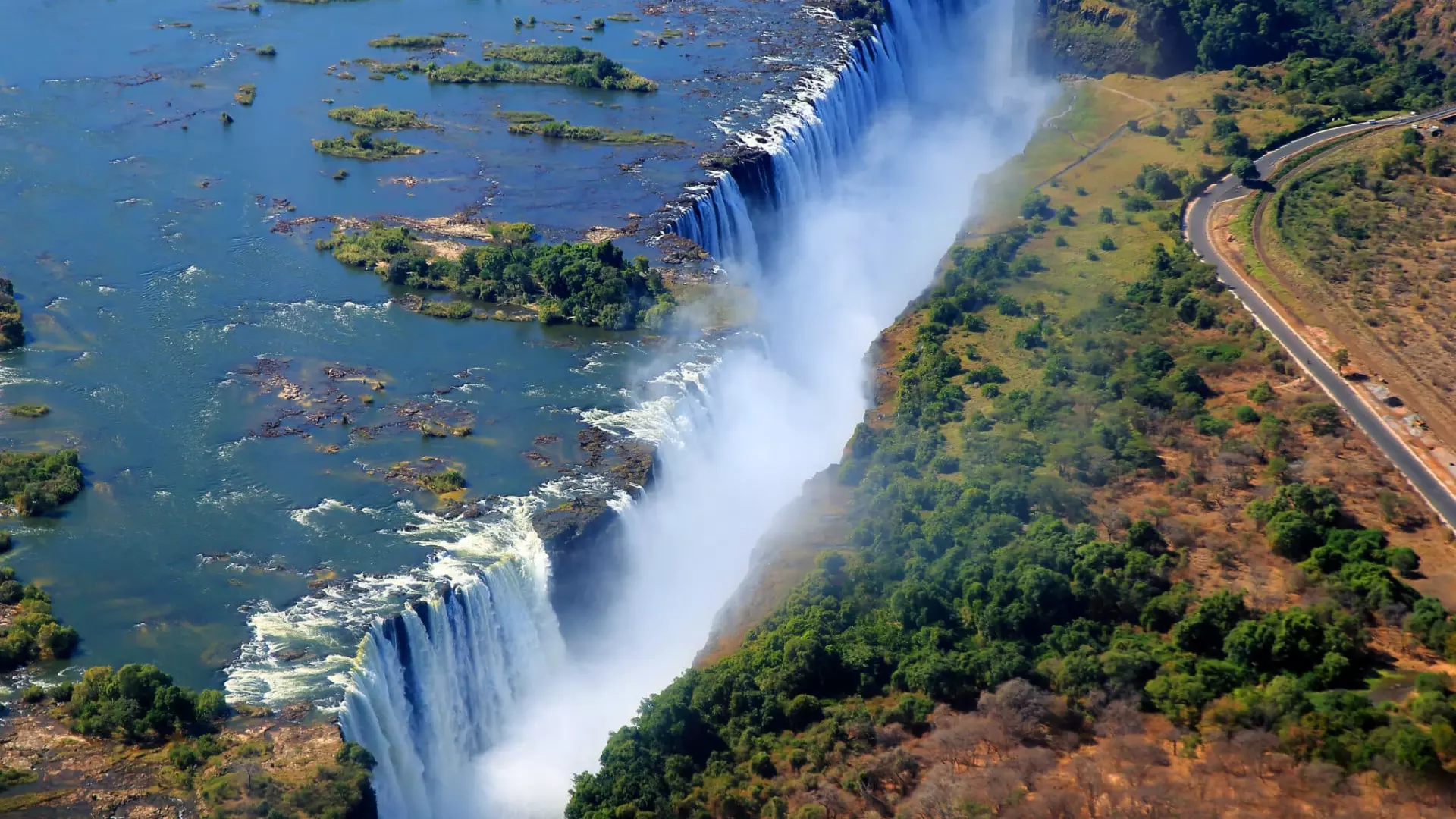
The Victoria Falls In Five Perspectives

By Derek Mwale
There are places on the map that people visit, and then there are places that quietly observe people as they pass through them. Victoria Falls belongs to the latter category.
It does not just exist as a waterfall. It exists as a mirror—reflecting identity, ambition, memory, survival, and perception back at whoever stands before it. And depending on who you are, the Falls will never show you the same face twice.
This is the essence of the “One Place, Five Perspectives” format: the same physical location, but five completely different realities unfolding in parallel.
To understand Victoria Falls fully, you cannot rely on a single narrative. You have to fragment it—allow it to be seen through different lives, different expectations, and different levels of awareness.
Because truth, in places like this, is not singular. It is layered.
1. The Tourist: A Temporary Believer in Beauty
The tourist arrives with a camera in one hand and expectation in the other.
For them, Victoria Falls is not a place—they have already decided it is an experience. Something to be consumed, documented, and remembered later through images that attempt to preserve a feeling that cannot be fully captured.
They step out of the vehicle, adjust their sunglasses, and immediately hear it—the low, continuous roar that grows louder as they approach. It is not noise. It is presence.
The first glimpse is usually not a full view, but a fragment. A curtain of mist rising like smoke from a world that seems to be breathing. And then, suddenly, the scale reveals itself.
The tourist reacts instinctively:
- A pause
- A widened gaze
- A shift in posture
This is the moment where expectation meets reality, and reality wins without effort.
They take photos, not because they fully understand what they are seeing, but because they want proof that they were there. The Falls become a checkpoint in their personal timeline—a place that says, I have arrived somewhere significant.
For the tourist, Victoria Falls is awe.
But it is also temporary.
They will leave with souvenirs, photographs, and a story that will slowly compress over time into something shorter, something easier to retell. The depth of the experience will fade, but the label—“I visited Victoria Falls”—will remain.
To them, the Falls are a highlight.
To the Falls, they are just another observer passing through.
2. The Local Resident: Familiarity Without Indifference
For the local resident living near Victoria Falls, the Falls are not an event. They are background.
Not background in the sense of insignificance, but background in the sense of permanence.
They grow up hearing the sound before they ever consciously understand it. It becomes part of the environment in the same way as wind, birds, or distant traffic. Something always present, but rarely questioned.
Where the tourist sees spectacle, the local sees continuity.
They know the seasons:
- When the water rises
- When the mist thickens
- When the paths become slippery
- When the viewpoints change in character
They understand the rhythms of the Falls not as a destination, but as a living system that influences daily life.
For the local resident, Victoria Falls is not something to “visit.” It is something to live alongside.
Yet this familiarity does not translate to indifference.
There are moments—early mornings, quiet afternoons, evenings when the light softens—when even a resident pauses. Not out of surprise, but out of recognition. A subtle reminder that what they live next to is not ordinary.
The Falls are woven into identity:
- They shape conversations
- They influence livelihoods
- They appear in stories told to children
- They become part of how people describe home to outsiders
To the local resident, the Falls are not just geography.
They are inheritance.
3. The Guide: A Translator of Meaning
The guide stands between two worlds—the visitor and the place.
At Victoria Falls, the guide is not merely someone who points out directions or names viewpoints. They are interpreters of experience.
They have heard the same questions countless times:
- “How old is the Falls?”
- “Is this the biggest waterfall in the world?”
- “When is the best time to visit?”
But beneath those surface-level questions lies something deeper: the human desire to contextualize awe.
The guide understands that most visitors are not just looking—they are trying to make sense of what they see.
So the guide adjusts their storytelling depending on the audience:
- For some, they emphasize geological facts
- For others, cultural significance
- For others still, practical details and safety
They are constantly reading people:
- Their level of curiosity
- Their attention span
- Their emotional reactions
A good guide knows when to speak and when to let silence do the work.
Because sometimes, the Falls themselves are the best narrator.
The guide has a unique relationship with Victoria Falls. Unlike the tourist, their experience is repeated. Unlike the resident, their engagement is professional. They see patterns:
- What amazes people consistently
- What surprises them unexpectedly
- What they misunderstand
Over time, the guide becomes less of a storyteller and more of a bridge—connecting human perception to natural scale.
To the guide, Victoria Falls is not just a place.
It is a dialogue.
4. The Business Owner: Opportunity in Proximity
For the business owner operating near Victoria Falls, the Falls represent something different again: opportunity.
Where others see beauty, they see movement.
Where others see scenery, they see flow—of people, money, demand, and services.
The Falls attract visitors, and visitors create ecosystems:
- Hotels
- Restaurants
- Transport services
- Tour operations
- Craft markets
The business owner understands that the Falls themselves are not the direct source of income, but the magnet that brings potential customers into proximity.
Their mindset is shaped by questions like:
- How do I position my service within this flow?
- What does the visitor need before, during, or after their visit?
- How do I differentiate myself in a competitive environment?
They study behavior:
- When do tourists arrive?
- How long do they stay?
- What do they spend on?
- What experiences do they prioritize?
Unlike the tourist, who is focused on experience, the business owner is focused on sustainability.
The Falls, to them, are not static—they are an engine.
An engine that must be respected, maintained, and understood, because its health directly affects livelihoods.
There is also a subtle awareness: without the Falls, the ecosystem collapses. But because the Falls are permanent in appearance, it is easy to forget that the surrounding economy is entirely dependent on them.
To the business owner, Victoria Falls is not just a landmark.
It is infrastructure.
5. The Child Growing Up There: Normalizing the Extraordinary
For a child growing up near Victoria Falls, the Falls are neither a destination nor an economic concept.
They are simply part of life.
Children adapt quickly to what adults consider remarkable. What is labeled “world-famous” by outsiders becomes “just there” to someone who has always known it.
The child may visit the Falls during school trips, family outings, or casual walks. But the emotional response is different from that of a first-time visitor.
There is curiosity, yes—but not the overwhelming awe that defines tourists. Instead, there is familiarity mixed with occasional rediscovery.
For a child:
- The Falls are a playground of sorts
- A backdrop to growing up
- A place associated with memories rather than significance
They may not yet understand the global attention the Falls receive. To them, it is simply where they are from.
However, as they grow older, something begins to shift.
Through education, exposure, and interaction with outsiders, they start to realize:
- That people travel across continents to see what they see daily
- That what feels normal to them is extraordinary elsewhere
This realization often creates a subtle identity transformation.
What was once background becomes pride.
The child grows into an adult who can now explain their home not just from familiarity, but from awareness.
To them, Victoria Falls evolves from:
- A place they live near
into - A place they represent
And that transformation is powerful.
Because it bridges internal experience with external recognition.
The Overlapping Truth
When you layer all five perspectives together, Victoria Falls stops being just a waterfall.
It becomes a multi-dimensional space where:
- Awe meets routine
- Opportunity meets dependence
- Interpretation meets silence
- Familiarity meets rediscovery
Each perspective is valid on its own. But none of them alone is complete.
The tourist sees wonder.
The resident sees continuity.
The guide sees meaning.
The business owner sees opportunity.
The child sees normality evolving into identity.
And Victoria Falls itself remains unchanged—constant in its flow, indifferent to interpretation, yet somehow defined by all of them at once.
Final Reflection
“One Place, Five Perspectives” is not just a storytelling format.
It is a reminder that places are not experienced directly—they are experienced through people.
And people, in turn, are shaped by their relationship to place.
Victoria Falls is not just one of the greatest natural wonders in the world.
It is a living intersection of perception.
A single location carrying multiple truths simultaneously.
And the deeper you look, the more you realize:
The Falls are not only something you see.
They are something that reveals who you are.