
Chasing Water: A Journey Through Zambia’s Most Beautiful Rivers

By Derek Mwale
There is something about water that refuses to be ignored. It does not shout like cities do. It does not demand attention like monuments or skylines. And yet, in Zambia, water speaks—softly, endlessly, truthfully.
To chase rivers across Zambia is not just to travel. It is to listen. To slow down. To remember something ancient within yourself that the noise of modern life has tried to bury.
This is a journey—not across distance, but into meaning.
The Beginning: Where Water Feels Like Power
Every journey of water in Zambia inevitably bends toward one name: Victoria Falls.
But to reduce it to a destination is to misunderstand it.
When you stand before the falls, you do not simply see water—you feel it. The ground trembles beneath your feet. The mist rises like breath from the earth itself. The roar is not just sound; it is presence.
Locally, it is called Mosi-oa-Tunya—“The Smoke That Thunders.” And in that moment, you understand why. The water does not fall—it announces itself.
Yet, what most people miss is this: the falls are not the beginning of the story. They are only a moment in a much longer journey.
To chase water, you must follow it upstream. You must ask: Where does this power come from?
The Zambezi: A River That Knows No Hurry
The Zambezi River does not rush. It moves with intention, carving its way through landscapes, shaping ecosystems, feeding life in ways both seen and unseen.
At sunrise, the river becomes something else entirely.
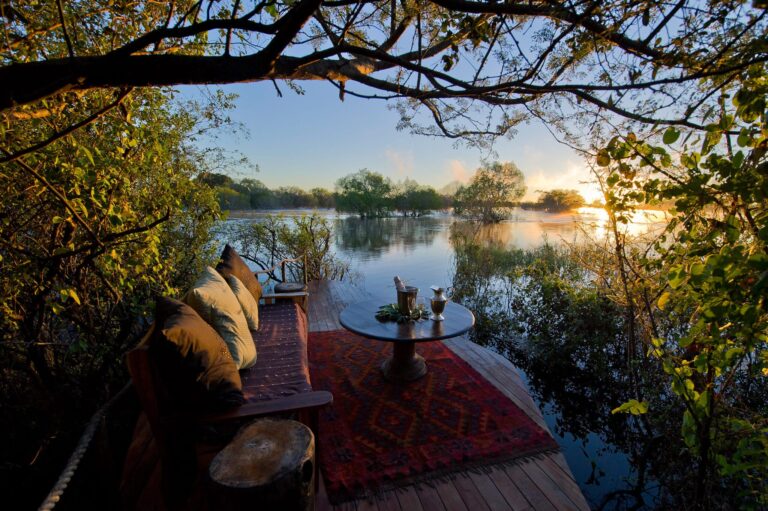
There is a moment—just before the sun fully rises—when the water turns into glass. Canoes drift quietly. Birds move like whispers across the sky. And everything feels suspended between night and day.
Here, time loses meaning.
You begin to notice things you usually ignore:
The rhythm of paddles dipping into water.
The distant call of fish eagles.
The way light dances on the surface, never staying still.
And slowly, you begin to understand something: the river is not in a hurry because it does not need to be. It will reach its destination regardless.
There is a lesson in that.
The Kafue: The Quiet Giant
If the Zambezi is power, then the Kafue River is patience.
Flowing through the vast Kafue National Park, this river does not seek attention. It hides in plain sight, winding through floodplains and grasslands, sustaining one of the richest ecosystems in Africa.
But you will not understand the Kafue from a photograph.
You must sit with it.
You must watch as lechwe antelope move through shallow waters, their reflections stretching and bending with every step. You must wait as the sun slowly sinks into the horizon, turning the river into liquid gold.
There is no rush here. No urgency.
And that is exactly the point.
In a world obsessed with speed, the Kafue reminds you that life does not need to be fast to be meaningful. Sometimes, the deepest experiences come in stillness.
The Luangwa: Where Life and Death Meet
Further east, the Luangwa River tells a different story.
This is not a gentle river. It is raw. Untamed. Honest.
Flowing through South Luangwa National Park, the Luangwa is the stage for one of nature’s most powerful dramas. Here, life and death exist side by side, inseparable.
At its banks, elephants gather. Crocodiles wait. Hippos dominate the water with a presence that feels almost prehistoric.
Nothing here is hidden.
You see the hunt. You see survival. You see the fragile balance that holds everything together.
And somehow, instead of fear, there is clarity.
Because the Luangwa does not pretend. It shows you life as it is—beautiful, brutal, and deeply interconnected.
To witness it is to be reminded that nature does not operate on comfort. It operates on truth.
The Lower Zambezi: Where the Wild Meets the Soul
As the Zambezi continues its journey, it reaches a place where the wild feels more intimate—more personal.
The Lower Zambezi National Park is not just a location. It is an experience.
Here, the river narrows. The landscapes shift. And the connection between human and nature becomes almost immediate.
You are no longer just observing—you are part of it.
Canoeing through this stretch is unlike anything else. There are no engines. No distractions. Just the sound of water, the movement of wind, and the awareness that you are sharing space with something much larger than yourself.
An elephant might appear at the riverbank, drinking slowly, as if time itself has slowed down for it.
And in that moment, something changes within you.
You stop thinking about your phone. Your deadlines. Your worries.
You become present.
Fully, completely present.
The Chambeshi: The Beginning No One Talks About
Most people chase endings. Very few chase beginnings.
The Chambeshi River is one of the most important rivers in Zambia—and yet, it remains one of the least celebrated.
It is here that one of Africa’s great water systems begins its long journey northward, eventually feeding into the Congo Basin.
But the Chambeshi does not announce itself like Victoria Falls. It does not demand attention like the Luangwa.
It simply exists.
Quietly. Steadily. Purposefully.
And maybe that is why it matters.
Because in life, we often overlook beginnings. We celebrate success, outcomes, and visible achievements—but we forget the quiet starts that made them possible.
The Chambeshi is a reminder: every powerful story begins somewhere small.
What Water Teaches Us
By the time you finish chasing rivers across Zambia, something shifts.
You begin to see patterns.
The Zambezi teaches you patience.
The Kafue teaches you stillness.
The Luangwa teaches you truth.
The Chambeshi teaches you humility.
And Victoria Falls reminds you of power—the kind that does not need permission to exist.
But perhaps the greatest lesson is this:
Water does not resist its path.
It flows. It adapts. It finds a way—around obstacles, through barriers, across landscapes that try to contain it.
And in doing so, it shapes the world.
The Ending That Is Not an Ending
To chase water in Zambia is to realize that there is no real ending.
Rivers do not stop. They continue—beyond borders, beyond maps, beyond what we can see.
And maybe that is the point.
Because life, like water, is not about reaching a final destination. It is about movement. Growth. Transformation.
It is about learning when to flow, when to be still, and when to fall with unstoppable force.
So if you ever find yourself lost—truly lost—come back to the rivers.
Stand at the edge of the Zambezi River. Sit beside the Kafue River. Listen to the silence of the Chambeshi River.
And remember:
The answers you are looking for have always been moving—quietly, patiently—within the flow of water.