Ansell’s Shrew: Zambia’s Little-Known Endangered Mammal

By Derek Mwale
Africa is famous for giants.
The towering giraffes.
The thunder of elephants.
The roar of lions across golden plains.
Travel brochures celebrate the “Big Five,” and for good reason — they are spectacular.
But nature holds another category of wildlife.
The quiet ones.
The creatures that live beneath leaves, under roots, and inside the shadows of forests. The ones that rarely appear in photographs but are just as important to the story of life.
Hidden in the grasslands and woodlands of Zambia lives one of these forgotten creatures.
Small.
Secretive.
Almost invisible.
Meet Ansell’s Shrew — one of Zambia’s most mysterious and endangered mammals.
A Creature Most People Never See
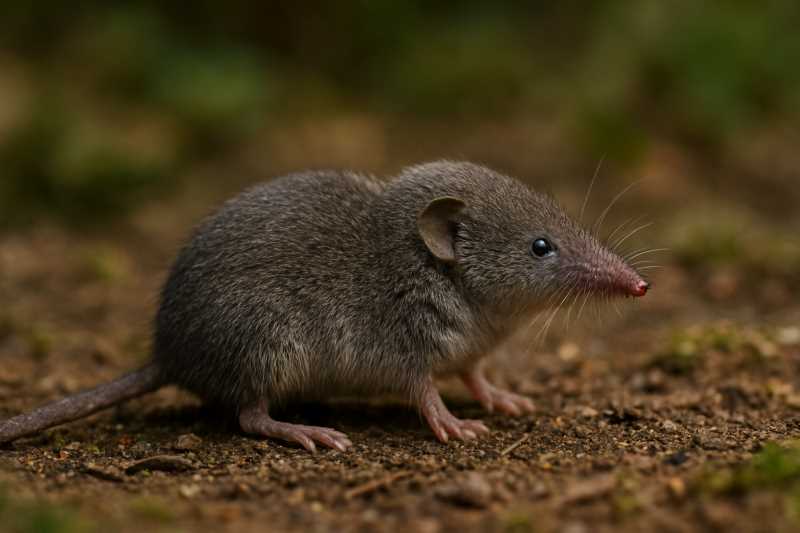
If you were walking through the bush in southern Zambia, you could easily pass within a few meters of Ansell’s shrew and never notice it.
It’s tiny.
Most adults measure only about 8–10 centimeters long, with soft gray-brown fur and a narrow pointed snout.
Its eyes are small.
Its movements are quick.
And its entire life happens close to the ground, beneath grasses and fallen leaves.
Unlike famous animals that dominate the landscape, this shrew survives by staying hidden.
It is a master of the unseen world.
Named After a Scientist
Ansell’s shrew carries the name of William Frederick Hamilton Ansell, a scientist who spent much of his career studying African wildlife.
During research in Zambia, Ansell helped document several species that had previously gone unnoticed by science.
One of those discoveries was this little mammal — a species so rare that for many years scientists knew almost nothing about it.
Naming the shrew after Ansell became a tribute to the work of researchers who explore the overlooked corners of the natural world.
Because sometimes the biggest discoveries come from the smallest animals.
A Life Lived at Ground Level
While lions rule the savanna and birds command the sky, Ansell’s shrew belongs to the hidden ecosystem of the forest floor.
This tiny mammal spends its days searching for insects, worms, and other small creatures among leaves and soil.
Its pointed snout acts like a natural probe, helping it sniff out food in the dark.
Its metabolism is incredibly fast.
So fast, in fact, that the shrew must eat constantly just to survive.
For a creature so small, every hour is a race against hunger.
But this relentless search for food plays an important role in nature.
By eating insects and helping control pest populations, shrews quietly support the health of entire ecosystems.
A Very Small Home
Unlike many animals that roam across continents, Ansell’s shrew has an extremely limited range.
Most records of the species come from specific areas within Zambia, particularly regions connected to forest and woodland habitats.
These environments are part of the vast natural landscapes surrounding areas like Kafue National Park — one of Africa’s largest protected ecosystems.
But outside protected areas, the habitats of many small mammals are shrinking.
Agriculture, land development, and deforestation slowly transform the natural environments where these creatures once thrived.
For a species that already lives in a limited range, even small changes can have big consequences.
Why It Is Considered Endangered
In the world of conservation, attention often goes to large animals — elephants, rhinos, and big cats.
But scientists know that small species can be even more vulnerable.
Because they depend so heavily on very specific habitats.
Ansell’s shrew is considered endangered primarily because of habitat loss.
As forests and natural woodlands are cleared for farming or settlement, the quiet microhabitats that support creatures like shrews begin to disappear.
And unlike large animals that can migrate long distances, small mammals often cannot simply move somewhere else.
Their survival is tightly connected to the land they were born into.
The Hidden Heroes of Ecosystems
It’s easy to admire animals we can see.
The elephant walking across a riverbank.
The giraffe silhouetted against a sunset.
But nature is built on millions of smaller lives working silently behind the scenes.
Creatures like Ansell’s shrew are ecosystem engineers.
They aerate soil while digging.
They control insect populations.
They provide food for owls, snakes, and other predators.
Without them, ecosystems would slowly fall out of balance.
The invisible workers of the wild are often the most important.
Zambia’s Lesser-Known Wildlife
When people talk about wildlife in Zambia, they usually mention famous attractions like South Luangwa National Park or the mighty Victoria Falls.
And those places deserve their fame.
But Zambia’s natural story is much richer than the animals tourists see on safari.
The country is home to thousands of species — birds, reptiles, insects, amphibians, and mammals — many of which remain understudied or rarely seen.
Ansell’s shrew represents that hidden side of Zambia’s biodiversity.
A reminder that the wilderness is full of secrets.
Why Small Creatures Matter
Imagine a giant puzzle.
Now imagine removing hundreds of the smallest pieces.
At first, the picture might still look complete.
But slowly the gaps grow larger.
Eventually, the entire image falls apart.
That is how ecosystems work.
Small species are the tiny puzzle pieces that hold the bigger picture together.
Protecting animals like Ansell’s shrew is not just about saving one species.
It’s about protecting the delicate web of life that connects everything in nature.
A Future Worth Protecting
The future of many small mammals depends on something simple:
habitat protection.
By preserving forests, grasslands, and natural ecosystems, Zambia protects not only the famous animals but also the countless small species that live quietly beneath the surface.
Conservation is not only about saving the spectacular.
It’s about respecting all life, even the creatures most people never notice.
The Final Reflection
In the wild landscapes of Zambia, giants walk beneath open skies.
But beneath the grass, in the quiet world of leaves and soil, smaller stories unfold.
Stories of survival.
Stories of adaptation.
Stories of creatures that have lived in these ecosystems for thousands of years.
The Ansell’s Shrew may be tiny.
It may be rarely seen.
But its presence reminds us of something powerful:
Nature’s greatest wonders are not always the loudest.
Sometimes they are the smallest.
And sometimes…
They are the ones that matter most.