The Chaplin’s Barbet: Zambia’s Only Truly Endemic Bird

By Derek Mwale
Some treasures shout.
Others whisper.
And sometimes, the rarest wonders on Earth are not the biggest animals, the tallest waterfalls, or the loudest spectacles.
Sometimes… they are small birds sitting quietly in the branches of an ancient fig tree.
Deep in the heart of Zambia, among farmland, forests, and warm African skies, lives a bird so special that it exists nowhere else on Earth.
Not in Asia.
Not in Europe.
Not anywhere across Africa.
Only here.
This bird is called Chaplin’s Barbet — Zambia’s only truly endemic bird.
And its story is one of mystery, beauty, and quiet survival.
A Bird the World Almost Never Knew
Imagine walking through a grove of wild fig trees somewhere near the farming lands south of Lusaka.
The air is warm.
Cattle bells ring in the distance. Farmers tend their fields. The African sun stretches across the sky like a golden canvas.
Then you hear it.
A soft, rhythmic call echoing through the trees.
It’s not loud.
It’s not dramatic.
But to bird lovers and conservationists around the world, that sound is pure treasure.
Because it belongs to a bird found only in Zambia.
The Chaplin’s Barbet.
The Bird With the Polka-Dot Suit
Nature loves creativity.
And when it designed the Chaplin’s Barbet, it went all out.
This small bird looks like it’s wearing a stylish African outfit.
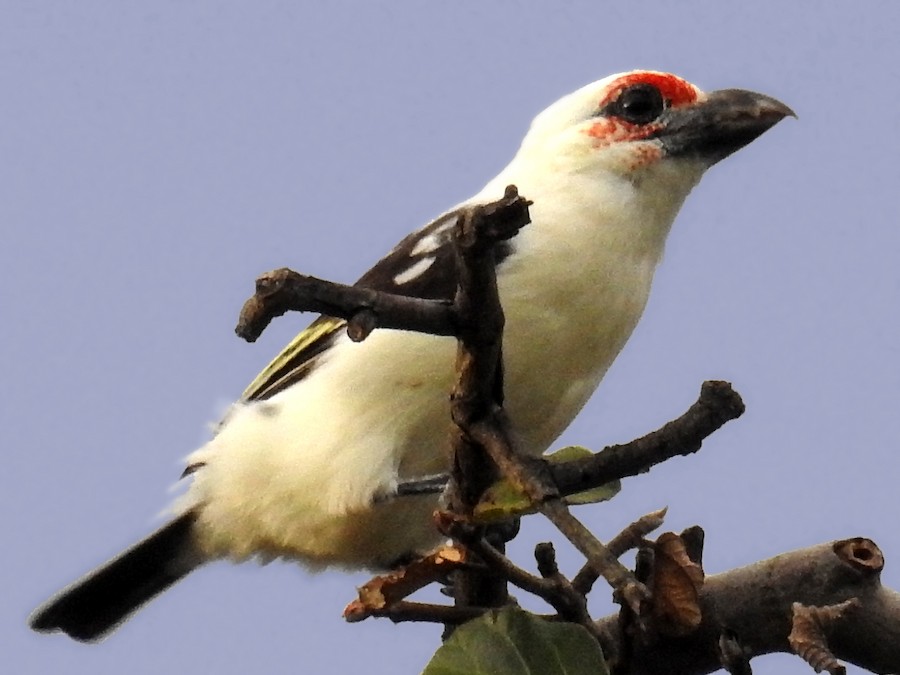
Black feathers covered with bold white spots decorate its body like polka dots on a midnight sky. Its bright red face glows like a tiny sunrise hidden among the leaves.
It’s striking.
Elegant.
And completely unforgettable once you see it.
Birdwatchers from across the world travel thousands of kilometers hoping to catch a glimpse of this rare creature perched quietly on a branch.
But the bird doesn’t show itself easily.
It prefers the quiet life.
The Kingdom of the Fig Trees
The Chaplin’s Barbet is a picky resident.
It lives almost entirely in open woodland areas filled with fig trees, especially the wild fig species that dominate certain landscapes in southern Zambia.
These trees are more than homes.
They are restaurants, playgrounds, and nurseries for the bird.
The figs provide food throughout the year, and the soft wood of the trees allows the birds to carve out nesting holes where they raise their chicks.
For the Chaplin’s Barbet, fig trees are life.
Remove the trees… and the bird’s kingdom disappears.
A Name With History
The Chaplin’s Barbet carries a name that sounds like it belongs in a storybook.
The bird was named after Sir Francis Drummond Chaplin, a British administrator who once served in Northern Rhodesia — the territory that would later become Zambia.
But while the name came from colonial history, the bird itself belongs entirely to Zambia.
It has lived in this land long before borders were drawn.
Long before maps existed.
Long before people understood how rare it truly was.
Zambia’s National Bird
Some countries choose lions or eagles as their national symbols.
Zambia chose something different.
Something humble.
Something uniquely its own.
The Chaplin’s Barbet was officially declared the national bird of Zambia.
And for good reason.
It represents something powerful: identity.
In a world where many species roam across continents, this bird belongs only to one nation.
Only one home.
Only one sky.
And that sky is Zambia’s.
The Small Range of a Big Treasure
The Chaplin’s Barbet does not travel far.
Unlike many birds that migrate across continents, this species lives in a surprisingly small area of southern Zambia — particularly around regions like Choma, Namwala, and surrounding farmlands.
Its entire global population exists within a relatively small geographic range.
That makes it incredibly special.
But it also makes it vulnerable.
When a species lives only in one place, the fate of that place becomes the fate of the species itself.
A Quiet Conservation Success Story
For many years, scientists feared the Chaplin’s Barbet might disappear.
Farming expansion, deforestation, and habitat loss threatened the fig tree woodlands where the bird lived.
But something beautiful happened.
Local communities began to understand the importance of protecting the bird’s habitat.
Farmers preserved fig trees.
Conservation groups studied the bird and raised awareness.
Birdwatchers from around the world began visiting Zambia just to see it.
Slowly, the story began to change.
Today, the Chaplin’s Barbet is considered stable, and its population appears to be holding strong.
It’s proof that when people respect nature, nature can survive.
A Pilgrimage for Bird Lovers
For birdwatchers, spotting the Chaplin’s Barbet is like finding hidden treasure.
Travelers come from Europe, America, Asia, and across Africa hoping to see this rare species in its natural habitat.
And when they finally do…
There is always a moment of silence.
A moment where the camera lowers, and the traveler simply watches.
Because sometimes the greatest reward in nature is not the photo.
It’s the moment itself.
A tiny bird.
A fig tree branch.
And the knowledge that you are witnessing something that exists nowhere else on Earth.
The Symbol of a Nation’s Natural Heritage
The Chaplin’s Barbet is more than a bird.
It’s a reminder.
A reminder that Zambia holds wonders the world has barely begun to explore.
From the thunder of Victoria Falls to the quiet wetlands of Bangweulu Wetlands, the country is filled with natural stories waiting to be told.
And sometimes the most important stories are not the loudest.
They are the quiet ones.
The ones hidden in trees.
The ones singing softly at sunrise.
The Final Reflection
If you ever walk beneath the fig trees of southern Zambia and hear a gentle call echo through the branches, pause for a moment.
Look carefully.
Somewhere among the leaves might be a bird wearing a red mask and a polka-dot coat.
A bird that belongs only to this land.
A bird that carries the identity of a nation in its wings.
The Chaplin’s Barbet.
Small.
Beautiful.
And proudly Zambian.
Because sometimes the rarest treasures on Earth are not hidden in distant galaxies.
Sometimes…
They are perched quietly in a tree, waiting for the world to notice.